
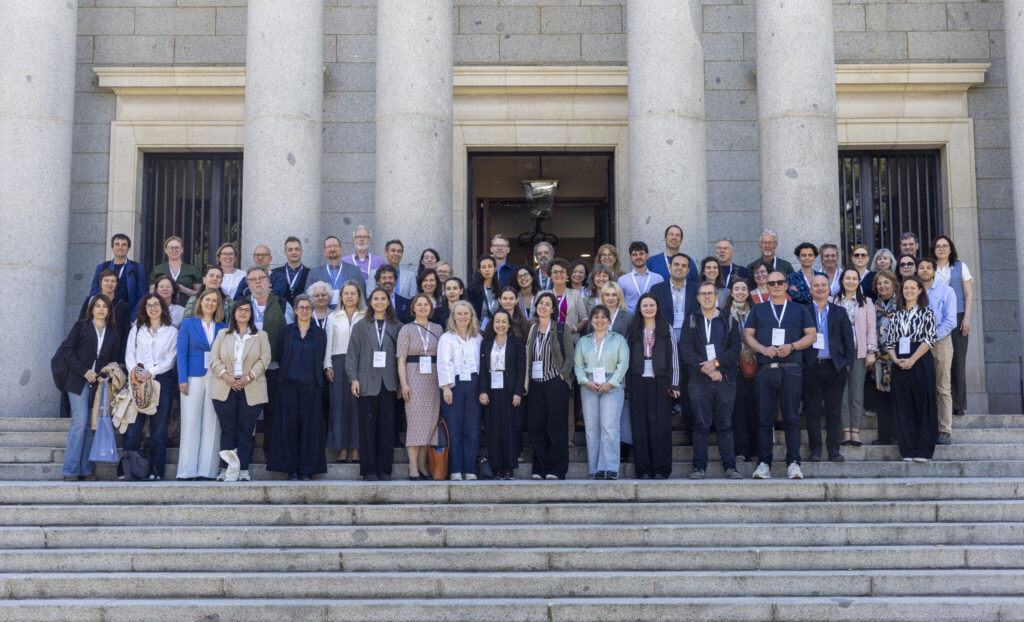
The Croatian Competence Centre for Social Innovation had the opportunity to participate in the National Competence Centres Mutual Learning Event “Social Innovation Portfolios in Practice: Building Advocacy for Systemic Change”, held in Madrid on 4–5 May 2026. The event was organised by the European Competence Centre for Social Innovation through the National Competence Centres Working Group under the ESF+ Community of Practice on Social Innovation, together with the Transnational Calls Team. The meeting brought together National Competence Centres from across Europe to share how the portfolio approach is being used to move beyond isolated projects and drive systemic change in some of the most complex social challenges of our time — from deinstitutionalisation and long-term homelessness to disability inclusion and care system reform.
At the heart of the discussions was Spain’s Social Innovation Portfolio VIDAS – A New Model of Community-Based Care, presented by the Spanish Secretariat of State for Social Rights as a concrete example of what the portfolio approach looks like in practice.
Why the portfolio approach matters
Across Europe, funders and policymakers struggle to develop and mainstream solutions to societal challenges within complex, often contested systems. Persistent issues such as homelessness, long-term unemployment, disability inclusion, and environmental vulnerability cannot be solved through single, stand-alone innovations. They require adaptive, system-level approaches that recognise power dynamics, elevate marginalised voices, and enable continuous learning across multiple sectors and interventions.
A portfolio of experimentation and mainstreaming connects various initiatives and all relevant actors in real time. This enables a shift from a project-based approach to a broader, system-level perspective — allowing the management of risks associated with disruptive initiatives, the natural acceptance of trial and error, and the strategic reinforcement of those initiatives that produce the strongest evidence of impact.
What is an innovation portfolio?
An innovation portfolio is neither an inventory of projects nor a comparison of results. It is an enabling architecture that connects initiatives and learning, makes visible the relationships between innovations, and facilitates their combination, mutual reinforcement and incremental value generation. Its core premise is simple but powerful: the impact of the whole can be greater than the sum of the results of each project individually — provided there is a shared mission orienting the whole. Portfolio approach means that innovators and decision makers work together in enabling innovation and following up with policy change for full implementation and/or scaling.
Funding isolated projects produces results. Managing a mission-oriented portfolio, by contrast, produces cumulative knowledge about which combinations of innovations work, where the gaps in the system are, which structural barriers recur, and what conditions make scaling and transfer possible. This is the kind of strategic intelligence no individual project can generate on its own — and it is precisely what enables better-informed public policy decisions.
The VIDAS Portfolio: purpose and mission
The Spanish Secretariat of State for Social Rights launched a strategic commitment to social innovation as a lever for systemic change. The result was the VIDAS Platform (Vías Innovadoras para la Desinstitucionalización a través de los Aprendizajes en Sociedad), which funded 19 pilot projects between 2022 and 2024 and coordinated them as a shared space for experimentation, exchange and learning. From this process emerged the Innovation Portfolio for a New Model of Community-Based Care, with a clear mission: to advance towards a new model of care and support that makes community living a real choice. VIDAS built this framework collectively, throughout the process itself, agreeing on seven shared principles: human rights, gender and intersectionality, independent living and autonomy, community-based approach, person-centred, comprehensiveness, mainstreaming and co-production. These principles are not a declaratory preamble but the cultural infrastructure that makes collective learning possible.
One of the most useful contributions of the VIDAS Portfolio is its honesty about the barriers to scaling, which appear in three recurring forms:
- Regulatory – rigid frameworks, technical regulations, procurement processes and housing legislation designed for the institutional model.
- Financial – budget structures built around pre-defined devices, with evaluation cycles that prioritise immediate results and ignore preventive value.
- Cultural and organisational – transformation can revert without sustained accompaniment, and community-based models may drift back toward institutional logic.
These barriers are systemic and interconnected. Regulatory reform without cultural change does not produce real transformation, and cultural change without adjusted financing frameworks cannot be sustained.
National Competence Centres and the portfolio approach
A particularly resonant part of the Madrid discussions concerned the role of National Competence Centres for Social Innovation in supporting portfolio-based work. The Spanish experience offers important reflections for all NCCs across Europe, including ACT Group as Croatia’s National Competence Centre. A competence centre that operates as a catalogue of good practices has limited value when facing challenges like deinstitutionalisation, care reform or social inclusion. These challenges require cultural, organisational and regulatory change involving multiple actors over time. A centre, therefore, should operate with a mission-oriented portfolio logic — not managing isolated projects but articulating innovation ecosystems, sustaining collective learning, and connecting distributed experimentation with public decision-making.
The role of the centre should evolve across the phases of the innovation process:
- Inquiry phase – listening and mapping: identifying emerging challenges, articulating actors, making visible what exists, and signalling gaps no individual project can detect.
- Experimentation phase – articulation and accompaniment: facilitating innovations deployed in different contexts to share a common reference framework and generate cross-learning.
- Transfer phase – the most strategic: converting accumulated knowledge into orientations for public policy, identifying which models have conditions for scaling, and sustaining the link between those who experiment and those who decide.
- Evaluation – not a final phase but a transversal practice, a continuous learning system running through the entire process.
Crucially, the centre needs to be part of the innovation ecosystem as an active agent.
Three orientations for public policy
From the VIDAS evidence, the Portfolio formulates three orientations relevant for European institutions, Member States and competence centres alike: 1. Reorient financing frameworks towards support-based rather than device-based models, allowing flexible combinations adjusted to people’s needs.; 2. Broaden economic evaluation approaches to incorporate the temporal dimension of support, avoided costs and prevented crises.; 3. Build institutional architectures that connect experimentation with policy decision cycles — converting learning into financing criteria, regulatory frameworks and accreditation models on a continuous, not episodic, basis.
A shared European learning agenda
European National Competence Centres for Social Innovation are at very different stages of development. Some have consolidated institutional mandates, others — like our Centre in Croatia — are still building their role, methodologies and ecosystems. The Madrid mutual learning event made clear that the value of this network is precisely that learning does not have to start from scratch in each country. For our NCC, the Madrid meeting was both inspiration and confirmation: the portfolio approach is not a methodological option for complex systemic challenges — it is a foundational condition. As we continue to develop our role as Croatia’s National Competence Centre for Social Innovation, the VIDAS experience offers a tangible, evidence-based reference point for how mission, principles, distributed experimentation and continuous learning can come together to drive real model change.